Members Login
 
   Name :
 
   Password :
 
                   Login


:: PRODUCTS ::
Pacemaker
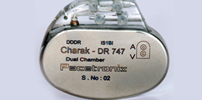
Permanent Pacemaker Model Charak 747 Dual Chamber
Pacemaker

CHARAK DDD 747 is a bicameral, programmable pulse generator The pacemakers can be programmed with the range of values of the parameters

Technical Specifications
u Pacing Modes
DDD, DDI, DOO, VDD, VVI, VVT, VOO, AAI, AAT, AOO, ODO.
u Basic Pacing Rates From 30 to 132 ppm.
u Maximum Rates From 60 to 147 ppm.
u Post Pacing AV Delays From 63 to 281 ms, in steps of 15.625 ms.
u Post Sensing AV Delays From 53 to 272 ms, in steps of 15.625 ms. (3 values depending on rate).
u Rates of Change of the Post Sensing AV Delay From 60 to 147 ppm.
u Blanking
From 21 to 68 ms, in steps of 15.625 ms
u Atrial and Ventricular Pulse Amplitudes 2.5, 3.5, 5.0 & 7.5 Volts.
u Atrial and Ventricular Pulse Widths From 0.122 to 1.464 ms in steps of 0.122 ms.
u Atrial and Ventricular Refractory Periods From 195 to 430 ms, in steps of 15.625 ms.
u Refractory Period Post Premature Ventricular Event From 195 to 430 ms, in steps of 15.625 ms, or VA period.
u Atrial Sensitivities 0.5, 1.0, 1.5, 2.0, 2.5, 3.0, 3.5, 4.0.
u Ventricular Sensitivities 1.0, 1.8, 2.6, 3.4, 4.2, 5.0, 5.8, 6.6.
u Upper Rate Behavior Off, Wenckebach, 2:1 block.
u Atrial Pacing Polarity Unipolar - Bipolar.
u Ventricular Pacing Polarity Unipolar - Bipolar.
u Sensing Polarity Unipolar - Bipolar.
u Coupled Pacing Delay OFF, 395 ms, 410 ms, 426 ms.
u Hysteresis 0%, 5%, 10%, 15%, 20% (single chamber modes)
 
Besides the information concerning the programmable parameters, it is also possible to obtain telemetry data about identification, battery status, statistics and marker pulses
u IDENTIFICATION Model and serial number.
u BATTERY STATUS BOL OK, ERI, EOL
u STATISTICS Number of events (sensed and paced). Being the pacemaker in the backup mode, number of given stimuli. Amount of times that interference was detected and number of given stimuli.
u MARKER PULSES Paced and sensed events.


Physical Characteristics

The CHARAK pacemakers are made with an hermetically sealed lithium-iodine battery

For better protection of the components from organic fluids, the electronic circuit and the battery are perfectly isolated into an hermetic titanium can.

The CHARAK size is 53 x 42 x 8.5 mm and its mass is 35 gr.

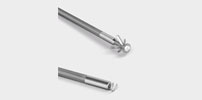
The connectors are made of stainless steel 316. The leads are fixed using screws that are adjusted with an Allen hex key. This key is included in the pacemaker blister.


Features
u MAGNETIC RESPONSE Asynchronous mode
At BOL and OK: the magnet rate is 90 ppm.
At ERI: the magnet rate is 85 ppm.
u BATTERY CHEMISTRY Lithium-Iodine WG 8950, Initial Voltage: 2.8 V, Capacity: 1.58 Ah.
u END-OF-SERVICE INDICATORS
u ELECTIVE (ERI): Battery remaining capacity between 4% and 8% of the total. When a magnet is applied the Magnet Rate is 100 ppm.
u END OF LIFE (EOL) Battery remaining capacity under 4% of the total. The period is 1000 ms (60 ppm)
u PROTECTIONS When the pacemaker senses events with a rate exceeding 11 Hz: a) if the programmed mode is DDD, DDI, or VDD, in presence of ventricular interference, it switches to VOO mode; in presence of Atrial interference, it switches to VVI mode.
b) if it is in a single chamber mode, it switches to an asynchronous mode.

TESTING THE PACEMAKER

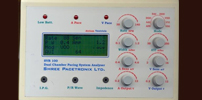
In order to test if the pacing output is enough to stimulate the heart, switch the working mode to an asynchronous one (using a magnet or the PCP+ programmer). Once the pacemaker mode has been changed, the stimuli can be detected using an electrocardiograph


Tachycardia Treatment

CHARAK DDD has two features for tachycardia treatment: the first one, temporary programming, consists in switching the pacemaker to an asynchronous mode at a special programmed rate. Usually a much higher rate than the basic one. The asynchronous pacing is maintained until the programmer head is put away from the pacemaker. In this moment, the pacemaker goes back to the original working mode. With the asynchronous stimulation at a high rate, the heart is stimulated in different moments of the cycle, helping to revert the tachycardia.

The second mechanism is enabled only when the pacemaker operates in VVI mode. It consists in sending coupled stimuli after the spontaneous QRS complexes, when the patient's rate exceeds the programmed upper rate. The delay time is also programmable. This mechanism does not revert the tachycardia, but it decrements the rate of effective contractions.

Business website from ssaralweb.com
© Copyright Pacetronix.com